
Do I Need a Local Attorney for a Cook Islands Trust?
No — proximity is the wrong criterion. What matters for a Cook Islands Trust is counsel whose practice is built around offshore asset protection.
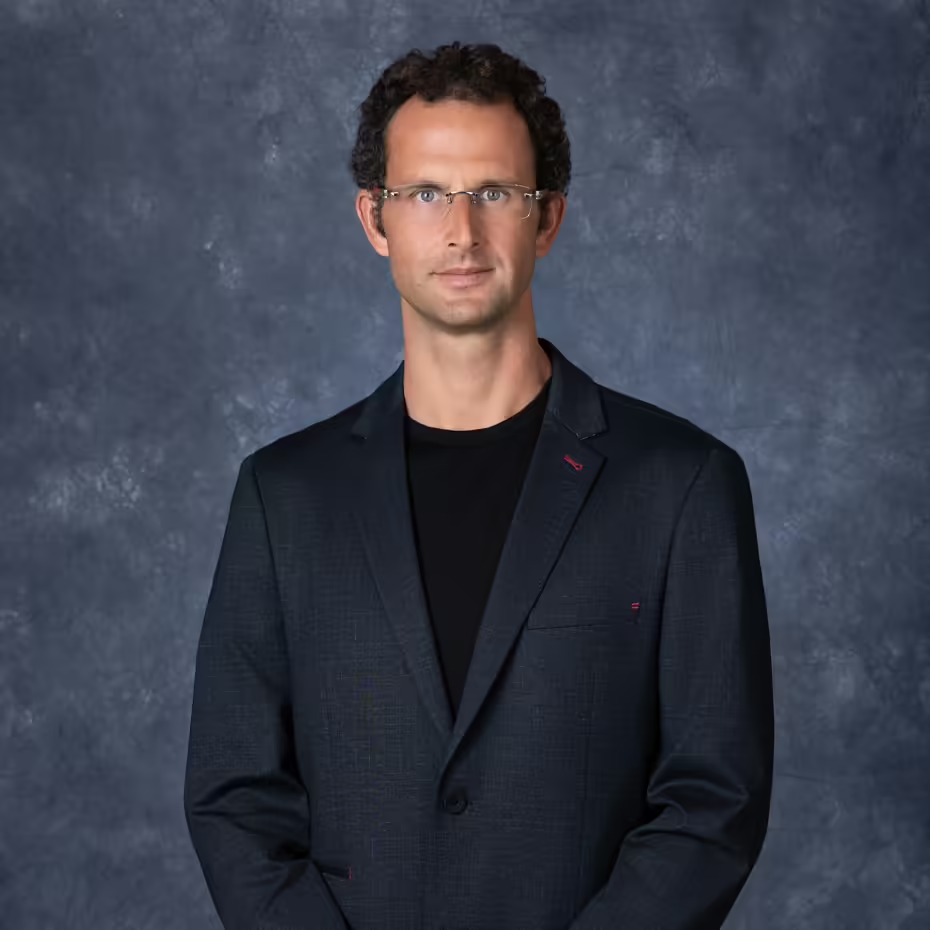 Blake Harris· Florida Bar #86486, Colorado Bar #45942
The Short Answer
No. A Cook Islands Trust does not require a local attorney, and for most clients, choosing counsel by geography would be the wrong move.
What matters for this kind of planning is finding a firm whose practice is built around offshore asset protection — direct working relationships with the Cook Islands trustees, current familiarity with the Cook Islands International Trusts Act and the case law that has tested it, and an established process for the U.S. tax and reporting obligations that come with foreign trust ownership.
Proximity to your home is rarely the right criterion. Focus is.
Why Most Local Attorneys Aren't the Right Fit
Cook Islands Trusts sit in a narrow corner of U.S. legal practice. A general estate-planning attorney, business attorney, or even a domestic asset protection attorney typically does not handle offshore structures — not because of skill, but because the work demands a different set of relationships and operational habits.
Setting up a Cook Islands Trust correctly requires:
- A drafted trust deed that includes the right duress clause, distribution standards, and trustee powers under Cook Islands law.
- A direct relationship with a licensed Cook Islands trustee who knows the firm and accepts new business.
- A working understanding of the grantor trust tax treatment so the structure is tax-neutral and IRS-compliant.
- An established process for Form 3520, Form 3520-A, FBAR, and Form 8938 — these are mandatory.
- Familiarity with the case law (FTC v. Affordable Media, the contempt-of-court line of cases) so the structure is built to hold up under pressure.
A local attorney can often handle a domestic trust, a will, or an LLC. A Cook Islands Trust is different. The wrong attorney is not unethical or careless — they simply do not have the relationships and repetition that this structure demands.
What to Look For Instead
When you're hiring counsel for a Cook Islands Trust, the questions worth asking are about depth, not distance:
- Does the firm focus exclusively on offshore asset protection?
- How many Cook Islands Trusts has the firm formed in the past year?
- Which Cook Islands trustees does the firm work with, and how long have those relationships existed?
- Will the firm handle the U.S. reporting itself or coordinate it with my CPA?
- What is the firm's track record on contested cases or creditor pressure?
These questions filter for the right kind of counsel regardless of where the firm is located.
Why Blake Harris Law Focuses Exclusively on This
Blake Harris Law is a law firm focused exclusively on offshore asset protection. We do not handle litigation, probate, divorce, document review, tax preparation, bankruptcy filings, or general legal services. Every engagement at the firm is built around the same core practice area — and the depth that comes from focus is what makes the difference for our clients.
Blake Harris co-founded Atlas Trust Company, a licensed Cook Islands trustee. That direct relationship means the U.S. attorney drafting your trust deed and the Cook Islands trustee accepting the trusteeship are operating from a shared understanding of the structure — not negotiating across two firms that have never worked together.
Our Offices vs. Our Service Area
Blake Harris Law maintains offices in Miami (headquarters), Los Angeles, Denver, and New York City. We are admitted to advise clients nationwide on offshore asset protection planning, and our client base extends across all fifty states.
The offices serve specific purposes: they provide a physical presence for clients who prefer to meet face-to-face, they anchor the firm in markets where high-net-worth clients tend to concentrate, and they support our bar admissions in those jurisdictions. They are not a constraint on who we serve.
If you live in Texas, California, Illinois, Florida, or anywhere else in the country, the process is the same as it is for a client across the street from our Miami office.
How the Remote Process Works
The entire engagement — from first conversation to a fully funded trust — runs on phone, video call, and DocuSign.
The initial consultation. Free, conducted by phone or video call (whichever you prefer), and protected by attorney-client privilege from the first minute. An attorney asks preliminary questions about your asset profile, your exposure, and your goals, then discusses whether a Cook Islands Trust is the appropriate structure (sometimes it isn't — see the comparisons with domestic asset protection trusts, Nevis trusts, and offshore LLCs).
Document signing. The engagement agreement can be conveniently signed electronically via DocuSign. Other documents may require notarization and/or a witness.
Paralegal walkthrough. Our paralegal team walks each client through onboarding via virtual meetings — KYC documentation, source-of-wealth verification, beneficiary information, asset inventory, funding logistics. No client has to figure out a document or a deadline alone.
Ongoing communication. After your trust is established, ongoing communication continues by phone, video call, and email. The same attorney who handled your initial consultation stays with you through funding and beyond.
Can I Meet a Member of BHL in Person?
Yes. Blake Harris Law offers in-person meetings to prospective clients for a flat $500 fee, payable in advance.
The default location is our Miami headquarters. Depending on the attorney's availability and travel schedule, meetings can also be arranged at one of the other cities we work with — or at another location across the U.S. when the schedule allows. We tell you up front what is workable for your timing.
To be clear: an in-person meeting is never required to set up a Cook Islands Trust. The entire engagement — from first conversation to a fully funded trust — runs remotely for the majority of our clients. The in-person option exists for clients who prefer face-to-face for their own reasons or who have particularly complex structures (multi-entity, operating businesses, unusual asset profiles) that benefit from a working session.
The Bottom Line
You do not need a local attorney for a Cook Islands Trust. You need counsel whose practice is built around this work — and the right firm for you is the one with the depth, the trustee relationships, and the operational habits that come from doing one thing.
If you have meaningful exposure to lawsuits and want to understand whether a Cook Islands Trust makes sense for your situation, the next step is a free, privileged consultation — at your convenience, from wherever you are.
Next step
Considering a Cook Islands Trust?
A confidential consultation. One business day response. No obligation, no paperwork until you're ready.
Frequently asked
Frequently asked questions
← All articleshttps://www.blakeharrislaw.com/articles/do-i-need-local-attorney-cook-islands-trust